

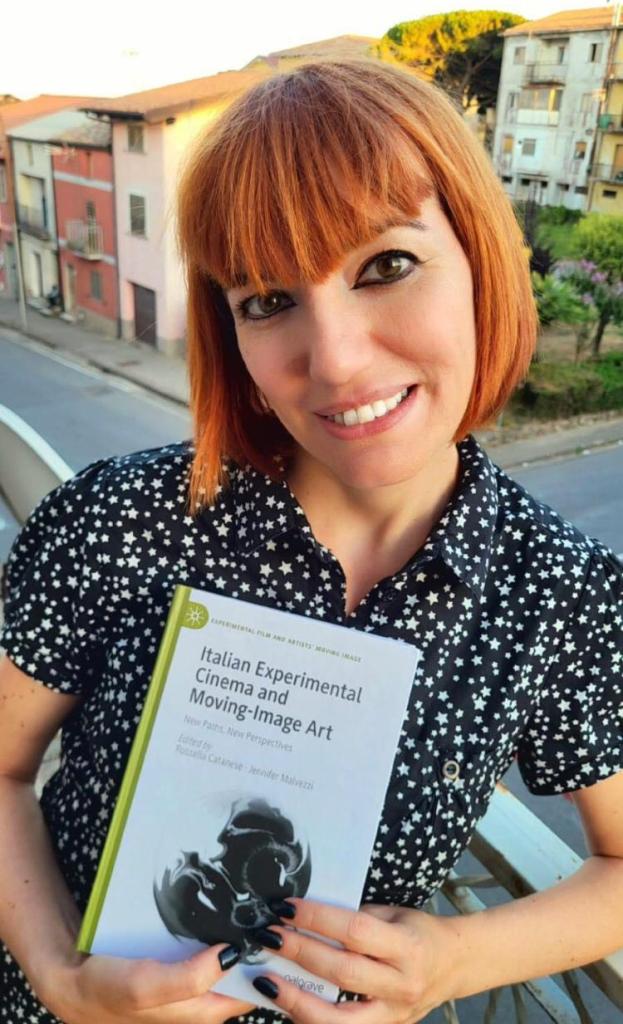
Your recent book Italian Experimental Cinema and Moving Image Art presents a compelling intersection of avant-garde film, archival engagement, and media theory. What central question or problem guided your research throughout this project?
Rossella Catanese: The central question driving Italian Experimental Cinema and Moving Image Art: New Paths, New Perspectives was how can we document and theorizeItaly’s overlooked experimental film and moving-image practices within a global context? Despite Italy’s rich cinematic history, its avant-garde and underground traditions—spanning Futurist films, postwar expanded cinema, video art, and contemporary digital experiments—have been marginalized in both national and international scholarship. This edited collection sought to bridge that gap by interrogating the aesthetic, political, and technological specificities of Italian experimental media while challenging the dominantnarratives that privilege mainstream, popular or auteur cinema.
Jennifer Malvezzi: We aimed to uncover how these works resisted industrial conventions, often blending with other arts (performance, painting, music) and using amateur and small-gauge formats like 16mm or Super 8 films. A key problem was reconciling Italy’s experimental ethos with its material conditions, from Fascist-era censorship to postwar countercultural movements. By assembling diverse scholarly perspectives, the book tries to frame Italian experimental cinema as a vital, yet understudied, force that redefines the boundaries of the medium itself.
What distinguishes the Italian experience of experimental moving image from its international counterparts, in your view?
Jennifer Malvezzi: The Italian experimental scene stands apart through its dialectical relationship with history and materiality. Unlike the formal purism of American structural film or the institutional support for French cinéma pur, Italian artists often worked in dialogue with—or defiance of—political upheavals.Postwar, Italy’s experimentalism thrived in interstitial spaces, divided between industrial patronage (e.g., Olivetti’s multimedia installations), and amateur networks. Works like Gianfranco Brebbia’s split-screen films or Alberto Grifi’s Vidigrafo reflected Italy’s strong tradition of artistic hybridization and political avant-gardes. Even in the digital era, artists like Rosa Barba or Paolo Cirio treat celluloid and data as contested sites of memory and control. This tactile engagement with medium specificity, alongside a penchantfor cross-disciplinary improvisation marks Italy’s unique contribution to globalexperimental practices.

You explore the role of archives and analog formats in shaping the aesthetics of experimental cinema. How does archival material function not just as source, but as a mode of thinking and creating in your analysis?
Rossella Catanese: Since it is an edited collection, we try to interpret the different authors’viewpoints in reconstructing the main lines of Italian experimental moving images. A common ground, that relies in our idea, is that archival material transcends mere source — it becomes an active methodology. Italian experimentalists often treat archives as palimpsests, where erasures, decays, and interventions embody historical memory. For example, Yervant Gianikian and Angela Ricci Lucchi’s found footage slows down colonial-era imagery toexpose violence embedded in the celluloid itself, turning archival discovery into a political critique. Similarly, Paolo Simoni and Mirco Santi’s restoration work at the Home Movies Archive reframes amateur films as collective counter-narratives to official history, intertwining experimental vocation and the bottom-up processes of display and reflect on the past. The materiality of analog formats—whether 8mm’s fragility or video’s magnetic distortions—shapes artistic choices. Figures like Leonardo Carrano exploit film’s chemical unpredictability, while contemporary collectives like Karmachina use videomapping to interrogate cultural heritage. Crucially, the performance with the archive is a core element for experimental cinema: live projections or hybrid digital-analog treat archival instability as generative.Here, the archive mirrors Italy’s fragmented historiography and invitesaudiences to participate in reconstructing meaning.
In your study, how does the body, space, and temporality operate within Italian moving image art? Are there recurring aesthetic strategies or political gestures unique to this context?
Jennifer Malvezzi: The Italian experimental tradition treats the body as a site of resistance and space as politically charged. In performance-based works, the filmmaker’s physical presence — handheld cameras, live projections and expanded cinema practices — blurs boundaries between creator and spectator, echoing the era’s collectivist politics. Similarly, the singular experiences, such as Carmelo Bene’s anarchic films in the 1970s fracture narrative time through grotesque bodily distortions, challenging both theatrical and cinematicconventions. Also space becomes a contested medium: expanded cinema pioneers like Umberto Bignardi use multi-screen installations to disrupt passive viewing. Temporality is often non-linear—Alina Marazzi’s Un’ora sola ti vorrei (2002) layers home movies to unravel familial and national memory, a strategy rooted in Italy’s fraught historical consciousness. Unique to Italy is the gesture of reclaiming: artists weaponize found material to critique power structures.
Would you say that Italian experimental cinema has developed its own form of media archaeology—one that emerges from artistic practice rather than academic discourse?
Jennifer Malvezzi: Absolutely. Italian experimental cinema enacts a tactile media archaeology—one where artistic practice precedes and disrupts academic theory. The Futurists’ unrealized film manifestos functioned as speculative archaeology, proposing radical uses of technology that later artists would literalize. For example, the Cineguf collectives under Fascism repurposed 16mm educational films to covertly explore abstraction, turning state- sponsored tools into subversive gestures. Bruno Munari’s light-projections with the Monte Olimpino Studio treated pre-cinematic devices (like slides or shadow play) as prototypes for participatory art, bridging historical gaps through live action, and treating technologies as living tools for interrogation. Here media archaeology here isn’t merely theoretical, but performative—a way to reactivate obsolete technologies as weapons against cultural amnesia. This practice-led archaeology is inherently political. Italy’s experimentalists privilege the haptic over the hermeneutic. Their work suggests that media archaeology is a poetics of interference, where glitches and erasures become acts of resistance.
In your work, media archaeology appears not only as a theoretical framework but also as an artistic methodology. How do you define media archaeology within your own practice, and how would you describe its relationship to media art? What kind of potential do you see in applying this approach to experimental cinema and moving image art?
Rossella Catanese: In this project, media archaeology operates as both lens and practice—a way to interrogate how artists dismantle linear histories through material engagement. Unlike traditional historiography, which often prioritizes canonized works, our approach aligns with Parikka’s notion of archaeology as “excavating the new from the old,” focusing on Italy’s minor media: obsolete formats or found footage approaches. This methodology’s kinship with media art lies in shared disobedience. Experimentalists help decode cinema’smechanical unconscious, transforming tools into critical agents. Their work mirrors Zielinski’s “anarchaeology,” where failure and hybridity (i.e. analog/digital glitches) can become sites of creativity, in the framework of “variantology”: probing media’s failures and marginalia to expose ideological constructs. By treating media artifacts as unstable witnesses, this approach democratizes history-making, plus enhances the awareness about the role of the moving image withing its material context.

Yorum bırakın